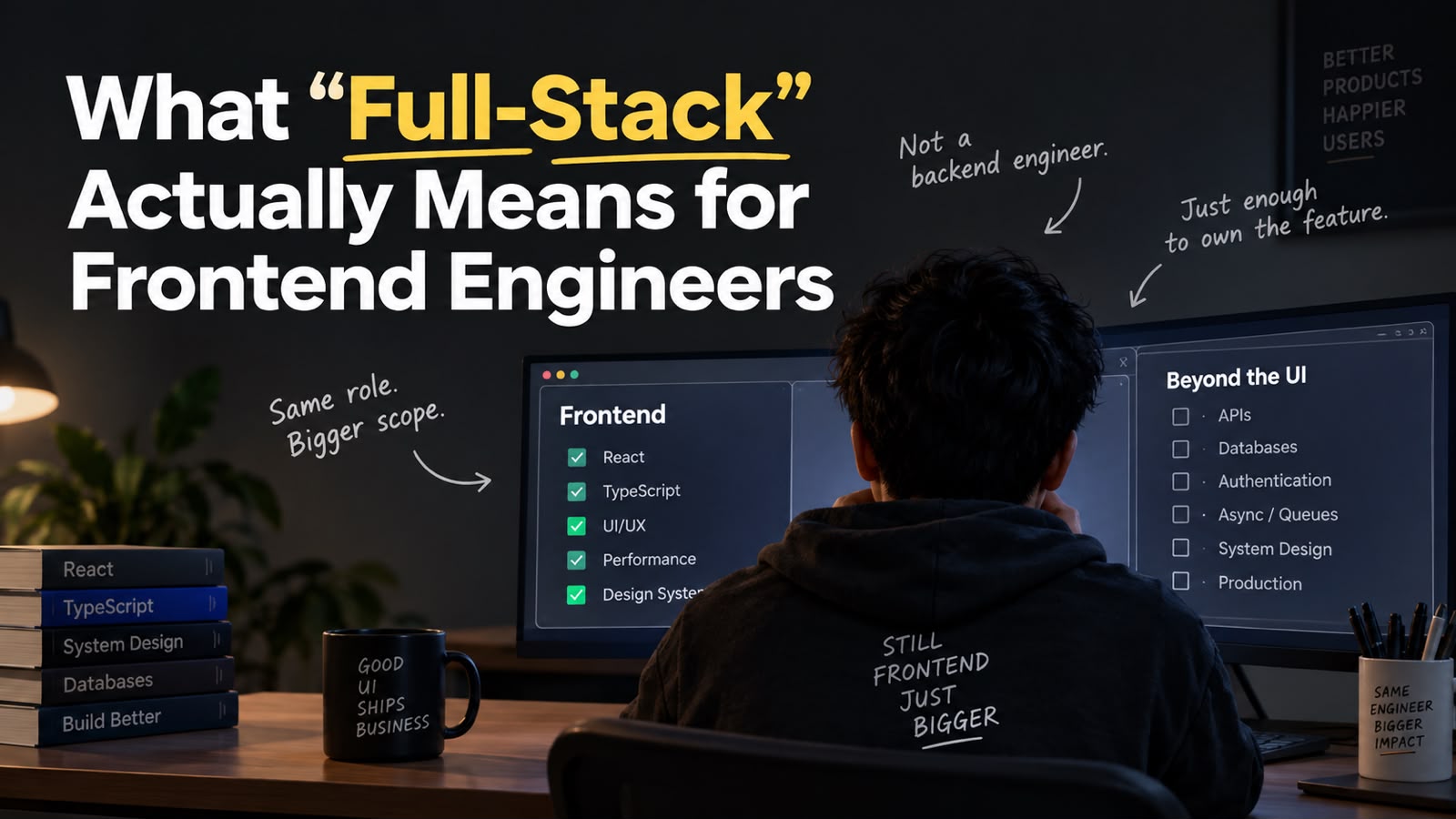
TL;DR
- Don't throw away 4–5 years of frontend depth to become a mediocre backend engineer.
- The market isn't asking for generic full-stack. It's asking for frontend-leaning full-stack — frontend depth plus enough backend and systems knowledge to own a feature end to end.
- AI raises the bar on understanding code, not writing it. Systems literacy is the moat.
Every few weeks someone messages me some version of this:
bhai, frontend mein future nahi hai kya? Should I start learning backend seriously? Node, databases, system design, sab kuch?
I get why they're asking. They keep seeing "full-stack" in job titles. They see AI generating React components in seconds. They see people saying:
Frontend is dying. Just learn backend. You need to become full-stack.
And then they panic: "Should I stop focusing on frontend and start learning everything else?"
I don't think that's the right move. I already wrote about whether frontend is dead. This is the career version of that answer.
If you've already spent 4–5 years getting deep into React, state management, browser behaviour, performance, accessibility, design systems, and frontend architecture, that depth is valuable. Don't throw it away because the job title changed.
The better move is: stay frontend-first, but become comfortable enough with backend and systems to own a feature end to end.
This isn't just my opinion. I read frontend job postings all day for OnlyFrontendJobs. Four live roles on the board today use almost the same language.
Why "just learn backend" is bad advice
There's a difference between backend literacy and becoming a backend engineer.
An actual backend engineer might spend years learning how to:
- design schemas
- reason about transactions
- build and own production services
- handle distributed systems
- design for failure
- operate infrastructure at scale
You don't become that person because you spent eight weekends learning Node.js. And pretending otherwise won't help you in an interview — a good interviewer can usually find the gap very quickly.
So if you're a frontend engineer with years of real depth, I wouldn't recommend throwing away your strongest skill and trying to become mediocre at everything. Instead: keep your frontend depth. Expand your engineering scope.
The roles are already showing this pattern
These four are live on OnlyFrontendJobs today. Two are IBM Canada (no sponsorship). N1 is NYC / US-Europe hybrid. Agoda is an engineering manager role in Bangkok with relocation. None of them is a Bengaluru IC job. The wording is still the signal: companies are writing frontend-leaning full-stack into the title.
IBM describes this as a full-stack role that leans UI-heavy. Most of the work is security and identity experiences on the frontend — auth, RBAC, secrets, audit logging. Engineers are also expected to touch identity microservices in Go or Java when a feature needs it.
It's not "become a backend engineer." It's "be strong on the frontend and capable enough across the stack to own the feature."
Another IBM role, this time on the billing POD. Frontend is still the majority of the work — billing and usage interfaces in React, Redux, and TypeScript — while the engineer also contributes to Go services and data pipelines.
Frontend isn't being replaced. The scope around the frontend is getting wider.
N1 puts it in the title: Frontend-Leaning Full Stack. The work is client-facing products — TypeScript, React, SolidJS — plus Node.js and PostgreSQL when the feature needs it.
You're still a frontend-heavy engineer. But you can't treat the backend as a black box anymore.
The pattern isn't limited to IC roles. Agoda's Front End / Full Stack Engineering Manager role is still TypeScript, React, and Redux at the core, with C#, Kotlin, and Scala in the wider environment.
As seniority increases, you're expected to understand more of the system around the frontend.
The pattern is easy to recognise once you see it: frontend remains a core strength, backend becomes part of your working knowledge, ownership expands beyond the browser.
Pay attention to the scope, not the title.
What "systems understanding" actually means
This is where most career advice gets vague. "Learn system design." "Understand distributed systems." "Know the backend." Okay — but what does that actually change about how you work?
Four examples.
1. APIs and how data actually moves
Feature: product listing with filters for price, category and availability.
Frontend-only thinking. The backend gives you an endpoint. You call it whenever the filter changes. Spinner. Render. Done.
Systems-aware thinking. You notice every filter toggle fires a fresh request. You start asking:
- Should these filters be combined into one request?
- Do we need debouncing?
- Is the backend doing expensive work for every change?
- Are we returning fields the UI never uses?
- What happens on a slow connection?
You're not designing the backend query. You're asking the questions that shape what gets built.
2. Authentication vs authorization
Feature: only the account owner can delete their listing.
Frontend-only thinking:
if (listing.ownerId === currentUser.id) {
  showDeleteButton();
}
Ship it.
Systems-aware thinking. Hiding the button isn't security. Anyone can call the API directly. So you ask: "Does the backend actually verify that this user owns the listing?"
Tip
Two words that aren't interchangeable
- Authentication — who are you?
- Authorization — are you allowed to do this?
You don't need to become a security engineer. You absolutely should understand this distinction.
3. Databases — enough to know where the problem might be
Feature: a recent-activity feed becomes slow for users with a lot of history.
Frontend-only thinking. "It must be React." Start optimising rendering. Add virtualization. Change pagination.
Systems-aware thinking. Before touching the frontend, ask: "What does the query behind this endpoint look like?"
- Is the filtering happening in the database?
- Is the relevant column indexed?
- Are we returning way too much data?
- Is the API doing unnecessary work?
Maybe the actual fix is a database index. You don't need to write the query. You need enough SQL and database knowledge to know what question to ask.
4. Queues and async systems
Feature: a user uploads a document and needs OCR + summarization before it's marked ready.
Frontend-only thinking. Call the API. Wait. Show a giant spinner.
Systems-aware thinking. OCR and summarization could take 30+ seconds. Now you're asking:
- Should this really be synchronous?
- What happens if the connection drops?
- What happens if the request is retried — could work be duplicated?
- Should this become a background job?
- How does the frontend know when processing is complete?
Maybe the right shape is: upload → background job → processing → event/status update → UI.
You're not necessarily the person building the queue. You're the engineer who catches the problem before someone builds the wrong thing.
Now add AI to the equation
AI is making routine code cheaper to produce. Components, hooks, forms, API integrations, tests, refactors. You can generate a lot of code now — so writing a React component quickly isn't as interesting as it used to be.
The harder part is knowing whether what was generated actually makes sense.
Take the delete-listing example. You ask an AI coding tool:
Build a delete listing feature where only the owner can delete it.
It generates the button, the hook, the API call, the backend endpoint, the tests. Everything looks reasonable. But did it actually enforce ownership on the server? Maybe the frontend check is correct while the API accepts any authenticated user. The code compiles. The UI works. You've shipped a security problem.
Warning
The real shift
Writing code and understanding code are becoming two different skills. AI compresses the first one. It doesn't touch the second one.
If you understand the system, AI becomes a force multiplier — trace a request through a codebase, explain an unfamiliar service, suggest edge cases, review generated code instead of blindly accepting it. If you don't understand what's happening behind the UI, it's much harder to spot when the answer is wrong.
So what should you actually learn?
If you're already strong at frontend, build in this order:
- Deep frontend expertise — keep sharpening it. This is your leverage.
- Backend literacy — enough to work effectively with the people who own the backend.
- Systems understanding — the four examples above, applied to your real work.
- AI as a productivity tool — used to review, explore, and pressure-test, not to autopilot.
- End-to-end ownership — the outcome of the four above.
Backend literacy means being comfortable enough to:
- read an API contract
- understand HTTP and data flow
- reason about authentication and authorization
- read basic SQL
- recognise common database problems (N+1, missing indexes, bloated payloads)
- understand caching at a high level
- recognise when work should be asynchronous
- understand queues and events conceptually
- trace a request across the stack
- debug problems that aren't strictly inside the browser
You don't need to master backend engineering. You need to stop treating the backend as a wall.
If you're preparing for your next role
Something very practical:
1. Pick 3–5 roles you actually want
Don't randomly learn technologies. Start with the job descriptions. Frontend-leaning full-stack roles are usually far more specific than "know everything."
2. Build literacy around those requirements
If the roles mention:
- Node → understand APIs, services and async work.
- Postgres → understand schemas, indexes and queries.
- Kafka → understand events, producers/consumers and why queues exist.
- Auth → understand sessions, tokens, authentication and authorization.
Enough knowledge to work effectively with the experts — not to replace them.
3. Be honest in interviews
Don't say:
I'm basically full-stack.
…if you aren't. Say:
I'm frontend-deep. I understand the systems around the frontend well enough to own a feature end to end, and I'm actively expanding my backend depth.
That's a stronger position. It's honest. And you have something real to back it up.
The move isn't frontend → backend
It's:
frontend depth → backend literacy → systems understanding → end-to-end ownership.
The goal isn't to become the world's average full-stack engineer. It's to become an excellent frontend engineer who can operate across the system. When I look at the roles above, that's increasingly how companies are describing the opportunity too.
Instead of asking "Is frontend dead?" — a better question:
What are companies actually hiring frontend engineers to do now?
Note
About OnlyFrontendJobs
I built OnlyFrontendJobs around more than keyword matching — so frontend engineers can find roles where their frontend expertise is actually the centre of the job, including the growing category of frontend-leaning full-stack roles.